
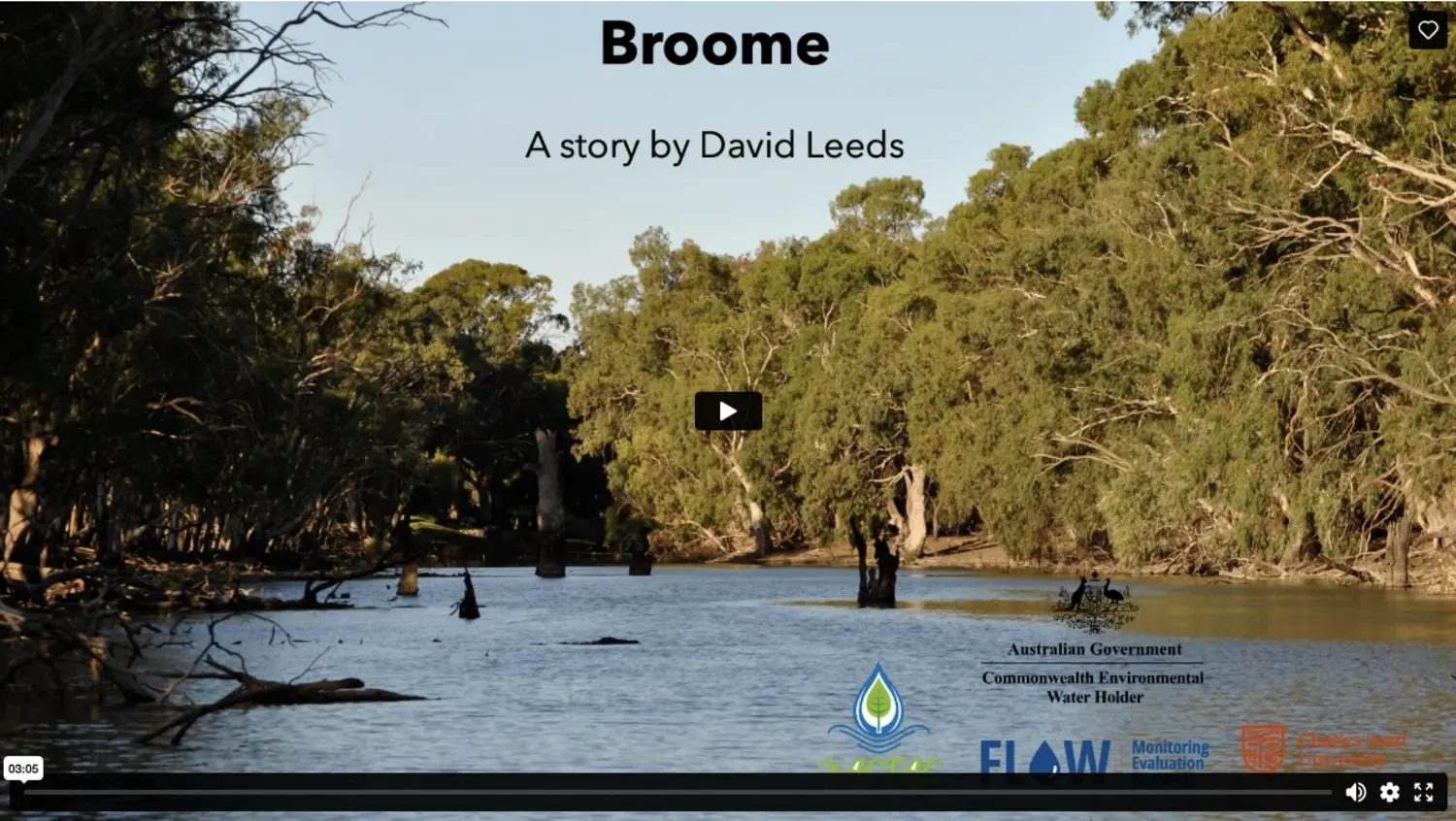
Written and narrated by David Leeds
Edited by Dr. Fleur Stelling and Karen Luckel
Acknowledgement of First Nations People crafted by Nioka Dupond
This story from farmer David Leeds explores his connection to the Yanco Creek and Broome wetland on his family property near Jerilderie. The area is part of the Yanco Creek system, which provides habitat for endangered species such as the Southern bell frog and eel-tailed catfish. Living beside the creek David has seen firsthand how the waterway and wetland have changed over time, and why they are important to both people and wildlife.
In this story, David describes his decision to work with scientists to help protect and manage the Broome wetland, which is supported by environmental flows. The story highlights themes of family, respect for nature, passing this care on to young people, and taking responsibility as a custodian of the environment for future generations.
Transcript
Slide 1
[video: Yanco Creek lined with river red gums.]
This story is about Broome…our family property.
Slide 2
[video: Aerial view of the property, featuring paddocks with large round hay bales, scattered remnant eucalypts, and Yanco Creek lined with eucalypts in the distance.]
The property is owned and operated by both my mother Gillian Leeds and myself. The property has been in Gillian’s family for 3 generations. Broome is a little bit under 3,500 acres and is located 30 km north of Jerilderie on the Riverina Plains.
Slide 3
[video: Aerial view of Yanco Creek and the Broome property shearing shed.]
We run the property as a stud shorthorn and commercial angus beef cattle operation.
We have been conscious of not using industrial agricultural practices by limiting the use of industrial fertilisers and pesticides, opting for environmental friendly farming practices.
Slide 4
[video: The landholders embarking on a paddle on the creek from the shore (photo 1). The family paddling on the creek together (Photo 2).]
Living on the property has been fabulous for raising our family and our children learned to swim in the creek. We enjoy sitting out on the verandah watching and listening to nature drift by.
Slide 5
[video: Aerial view of Yanco Creek during an influx of water.]
We have been receiving environmental water at Broome for at least 10 years or so. When environmental water comes past we notice a change in the biodiversity.
Slide 6
[video: A swamp wallaby amongst the river red gums, rushes and other wetland plants.]
Some of the wildlife that we love seeing on the place are swamp wallabies, echidnas, kangaroos, rakali, flying foxes, goannas and a few species of turtles.
Slide 7
[video: A flock of dozens of corellas flying overhead.]
We really enjoy the birdlife. We have cockatoos, corellas, emus, wedge-tailed eagles and sea eagles among others… threatened species like the plains wanderer and the superb parrot.
Slide 8
[video: Several ibis perched on a eucalypt stag surrounded by healthy eucalypts and cumbungi.]
Our waterbird life is abundant. We have ibis, Australasian bitterns, mountain ducks, swans and brolgas.
Slide 9
[video: Southern bell frog (photo 1). Murray cod (photo 2).]
Scientists discovered endangered Southern bell frogs which led us to locking up the back waters of the creek into the Broome wetland and providing them with habitat protection. And having more native fish in the system must be better for the environment.
Slide 10
[video: Two rakali on a monitoring platform in the wetland at night.]
PhD student Emmalie did extensive monitoring of rakali on the Broome wetland. This formed part of her Doctorate.
Slide 11
[video: An aerial view of Yanco Creek lined with river red gums, showing the landholder’s jetty extending into the creek.]
We feel it’s important that scientists continue to monitor the wetland and creek system to give us a better understanding of how to utilise and protect the environment of the wetland.
Slide 12
[video: A school teacher and students planting into the shore of the wetland, with buckets of wetland plants in the foreground.]
We love having schools participate in habitat planting and revegetation. I could see on their faces how they enjoyed being in nature and getting their hands dirty.
Slide 13
[video: Aerial view of the landholder’s house on the bank of the Yanco Creek, with a scientist and landholder operating a drone to capture imagery.]
We are just custodians of the environment we live in so it’s imperative that we look to improve on what we have for future generations.
Slide 14
[video: The healthy Broome wetland with fallen timber and eucalypt stags in the foreground, and cumbungi, low growing wetland plants and river red gums in the background.]
I don’t believe in legacies, as they are forgotten in one generation. But if we set an example for the next custodians to follow, I think this wonderful environment that I live in can thrive.
Slide 15
[video: Final slide detailing acknowledgements and logos: Australian Government Commonwealth Environmental Water Holder Flow Monitoring Evaluation and Research, Charles Sturt University, and YACTAC (Yanco Creek and Tributaries Advisory Council Inc.)]

%20(1).jpg)